Written by Jovan Johnson, Esq., Structured Settlement & Annuity Specialist
Industry-Reviewed by Kevin Lowe, COO of Genex Capital, Structured Settlement Secondary Market Specialist
Updated September 14, 2026
A structured settlement hardship commutation is a process that allows an annuitant to convert some or all of their future structured settlement payments into an immediate lump sum of cash when they face a qualifying financial or medical emergency. Unlike a standard factoring transaction — where a third-party company purchases your payment rights — a hardship commutation may be processed directly with your annuity issuer, the life insurance company responsible for your payments.
Hardship commutations exist because structured settlements are designed to provide long-term financial security. But life does not always follow plan. When an emergency strikes and you’ve exhausted your other resources, you generally have two paths to liquidity: ask your annuity issuer whether it offers a direct hardship program, or work with a third-party factoring company in the secondary market. Each path has real tradeoffs, and the right one depends on your issuer, your timeline, and your specific circumstances.
📞 Call Annuity Freedom today at (877) 547-3672 for a free, no-obligation consultation and discover how much your structured attorney fees are worth.
Can I Access My Structured Settlement Payments Early?
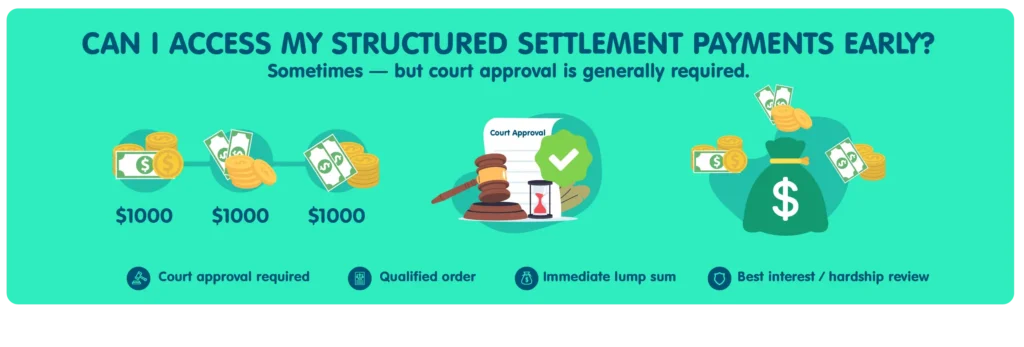
Structured settlement payments are intentionally difficult to accelerate. Under 26 U.S.C. § 5891 of the Internal Revenue Code and the state Structured Settlement Protection Acts (SSPAs) in force in all 50 states and the District of Columbia, your payments cannot be sold, assigned, mortgaged, pledged, or otherwise transferred without:
- A qualified order from a court of competent jurisdiction, and
- A finding that the transfer is in your best interest — or, in some states, is appropriate in light of a hardship you face.
Any transfer that fails to comply with § 5891 and applicable state law exposes the purchasing company to a 40% federal excise tax on the transaction. This legal framework protects you but also means you cannot simply request early payment — court approval is always required.
What Is the Difference Between a Hardship Commutation and Structured Settlement Factoring?
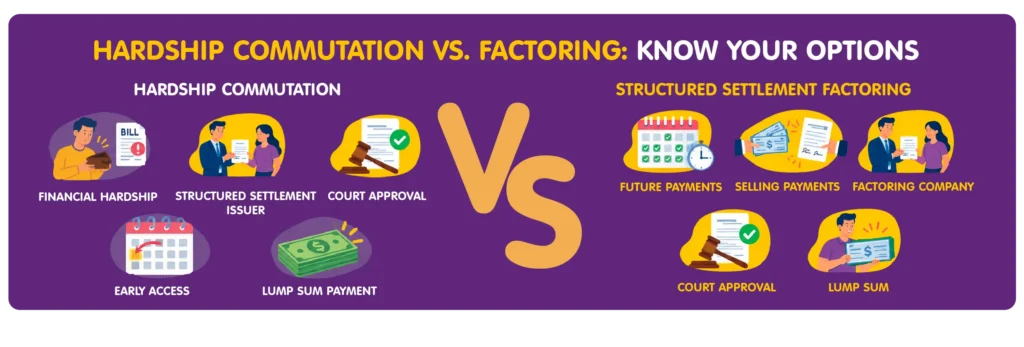
These two terms are often used interchangeably, but there is a meaningful legal and practical distinction.
| Hardship Commutation | Structured Settlement Factoring | |
|---|---|---|
| Who buys your payments | Your annuity issuer (the life insurance company) | A third-party factoring company |
| Discount rate | Can be lower when offered (e.g., 6.5% with Berkshire Hathaway’s Hardship Exchange Program) | Typically 9–18%, set by a competitive secondary market |
| Court approval required | Yes | Yes |
| Availability | Only offered by some issuers, often with narrow eligibility criteria | Widely available; many companies compete for your business |
| Approval standard | Issuer-set, frequently stricter than the legal minimum; many applications are declined | Court applies the state’s best-interest or hardship standard |
| Speed | Often slow — issuers are not staffed or structured to process these requests at volume | Generally faster, since purchasing payment rights is the company’s core business |
| Effect on annuity liability | The issuer terminates its obligation to make those payments | The issuer continues paying — to the factoring company instead of you |
The key difference isn’t that one option is good and the other is bad — it’s that they come from very different kinds of businesses. A structured settlement factoring company’s entire business model is purchasing structured settlement payment rights, so the process is built around doing that efficiently. An annuity issuer’s business is selling and administering annuities; buying back payment rights is, at most, a small program layered on top of that core business. That difference shapes what you can realistically expect from each path, which is covered in the next two sections.
Do Life Insurance Companies Offer Hardship Commutations?
Not all annuity issuers offer a direct hardship commutation option, but some do. Berkshire Hathaway is the most well-known example. Berkshire’s Hardship Exchange Program allows eligible annuitants to receive a lump sum directly from Berkshire in exchange for a portion of their future payment rights, using a 6.5% annual discount rate — lower than the rates commonly charged by structured settlement factoring companies. There is also a $1,000 administrative fee if the transfer is court-approved.
Other issuers, such as John Hancock, have been known to internally commute payments when presented with a qualified court order under § 5891. Allstate Life Insurance Company previously offered a similar program — the Advanced Funding Exchange Notice (AFEN) — at an 8% discount rate for its existing structured settlement annuitants. Allstate exited the structured settlement business in 2013 and no longer writes new structured settlement annuities; the AFEN program is referenced here as a historical example of what an issuer-direct hardship option can look like, not as a program currently available.
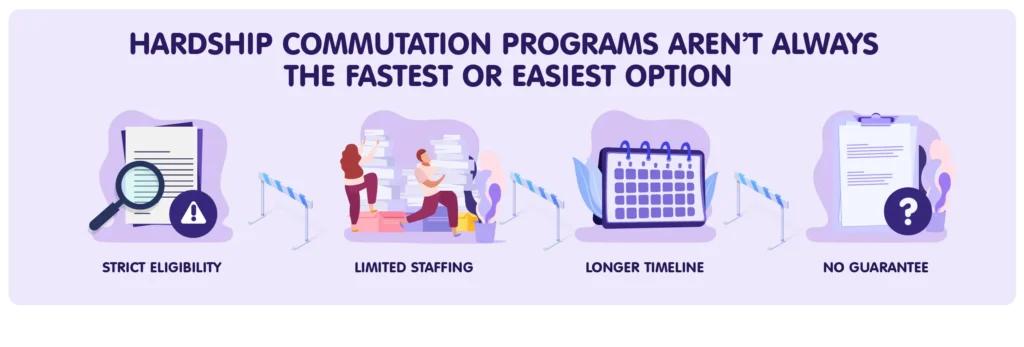
Why these programs are not always the fastest or easiest path. It’s worth understanding why a lower advertised discount rate doesn’t automatically make an issuer-direct hardship program the better choice for every annuitant. An annuity issuer’s core business is selling and managing annuities — not purchasing back the payment rights it has already issued. Buying back payments runs counter to the issuer’s normal revenue model, since it accelerates a liability the issuer would otherwise pay out over many years. As a result, issuer hardship programs tend to look different from a structured settlement factoring company’s process in a few practical ways:
- Stringent eligibility criteria. Issuers often apply a narrower hardship standard than the legal minimum required by federal or state law. Berkshire Hathaway, for example, applies its own hardship test rather than the more flexible “best interests” standard used in most state courts. Acceptance criteria are frequently undisclosed or applied at the issuer’s discretion, and many applications are declined.
- Limited staffing relative to demand. Because purchasing payment rights is not the issuer’s primary business, hardship programs are typically run by a small team layered on top of other responsibilities — not a dedicated transaction desk. This can mean longer wait times for a response, slower document review, and less flexibility if your situation doesn’t fit neatly into the issuer’s stated criteria.
- Slower overall timeline. Even after a hardship application is approved internally, the matter still has to go through court approval like any other transfer. Combined with the issuer’s internal review process, the total time from application to funding can take longer than working with a structured settlement factoring company that is set up to move transactions through efficiently.
- No guarantee of acceptance. Many issuers do not offer a hardship program at all, and among those that do, a meaningful share of applicants are turned down. If you’re declined, you haven’t lost anything by trying — but you also shouldn’t count on this path as your only option.
If your annuity issuer offers a hardship program, it’s worth a phone call to find out the terms before you commit to anything else — there’s no cost to asking. But because availability, timelines, and approval odds vary significantly by issuer, it should be treated as one option to explore rather than the default first step for everyone.
What Qualifies as a Hardship? Federal and State Definitions

“Hardship” is not one-size-fits-all. The federal law establishes the baseline, but each state SSPA defines — or treats — hardship differently. Some states codify an explicit statutory definition. Others apply a broad “best interests” test that does not require hardship at all. A few, like Kentucky, require a strict hardship showing as the primary approval standard.
What follows is a summary of how the federal law and key state statutes define or treat hardship for structured settlement payment transfers. Because this is a legal matter, you should consult with a qualified attorney about the specific requirements in your state.
Federal Law — 26 U.S.C. § 5891
Federal law does not define “hardship” explicitly, but it conditions the tax-exempt status of a transfer on a court finding that the transaction either:
- is in the best interest of the payee, taking into account the welfare and support of the payee’s dependents, or
- is appropriate in light of a hardship faced by the payee.
Both prongs satisfy the federal qualified order requirement. States are free to impose a stricter standard.
Source: 26 U.S.C. § 5891(b)(2)
California — Cal. Ins. Code § 10139.5
California does not separately define “hardship” as a standalone term, but its SSPA requires the court to consider a multi-factor “fair and reasonable and in the best interest” standard. Hardship is one explicit factor:
“Whether the payee, or his or her family or dependents, are in or are facing a hardship situation.” — Cal. Ins. Code § 10139.5(b)(13)
California courts must weigh this alongside 14 other enumerated factors, including the payee’s age, mental capacity, stated purpose for the transfer, financial and economic situation, and other means of support. A finding of hardship is not required for approval, but its presence or absence is directly evaluated.
Source: California Insurance Code § 10134 et seq. (Article 2.3)
Michigan — MCL § 691.1302 (Revised SSPA, Act 296 of 2006)
Michigan provides the most detailed statutory definition of hardship among all U.S. states. The Michigan SSPA defines “imminent financial hardship” as:
“the inability of the payee, because of a change in the payee’s circumstances after the execution of the initial structured settlement agreement, to purchase or pay for 1 or more of the following without the transfer: (i) Medical care or a medical device for the payee or the payee’s dependents. (ii) Living quarters for the payee. (iii) A motor vehicle necessary for the payee’s transportation if the payee has no other suitable transportation options. (iv) Education or job training expenses. (v) Debts of the payee resulting from child support, alimony, a tax lien, funeral expenses, or a judgment.” — MCL § 691.1302(e)
Michigan’s hardship standard applies specifically when the transfer conflicts with an anti-assignment restriction in the settlement agreement and the structured settlement obligor objects. In that situation, the court must find: (1) the payee will suffer imminent financial hardship if the transfer is not approved; (2) the transfer will not render the payee unable to pay current or future normal living expenses; and (3) the transfer order will restrict payment of the advance amount directly to the provider of the goods or services at issue.
Source: MCL § 691.1302(e) and § 691.1304
Kentucky — KRS § 454.431
Kentucky’s SSPA is one of the most restrictive in the country. It requires the payee to affirmatively establish hardship as a condition of court approval — a higher bar than the “best interests” standard used in most states. The statute provides that a court may approve a transfer only if:
“The payee has established that the transfer is necessary to enable the payee to avoid imminent financial hardship.” — KRS § 454.431(3)
Kentucky does not enumerate specific categories of hardship in the statute, leaving the factual determination to the court on a case-by-case basis. There is no independent professional advice requirement in Kentucky. As a result, Kentucky is considered one of the more difficult states in which to obtain approval for a structured settlement payment transfer.
Source: KRS § 454.431, enacted 1998 Ky. Acts ch. 409
West Virginia — W. Va. Code § 46A-6H-3
West Virginia requires either a demonstrated hardship or a separate best-interest finding, and explicitly addresses the future impact of the transfer. The statute requires that a court find that the payee has clearly demonstrated:
“(A) He or she, or his or her family is facing a financial hardship that the transfer would alleviate and that the transfer would not subject the consumer or the consumer’s family to undue financial hardship in the future; or (B) the transfer is in the best interest of the consumer.” — W. Va. Code § 46A-6H-3(1)
The disjunctive “or” means a court can approve without hardship under the best interest prong — but the explicit future-hardship protection (the transfer itself must not create new hardship) is notable and stronger than most state statutes.
Source: W. Va. Code § 46A-6H-3
New York — N.Y. Gen. Oblig. Law § 5-1706
New York’s SSPA applies a “best interests” standard and expressly clarifies that hardship is not required for approval:
“[T]here is no requirement for the court to find that an applicant is suffering from a hardship to approve the transfer of structured settlement payments under this subdivision.” — N.Y. Gen. Oblig. Law § 5-1706(b)
This language was added in a 2004 amendment to clarify legislative intent after early SSPA case law had treated “hardship” as a threshold requirement. Despite the flexibility, New York courts have historically scrutinized the fairness of discount rates and the reasonableness of fees as part of the best-interests review.
Source: N.Y. Gen. Oblig. Law § 5-1706 (General Obligations Law, Article 5, Title 17)
Most Other States — NCOIL Model Act / “Best Interests” Standard
The majority of state SSPAs — including those in Florida, Texas, Illinois, Pennsylvania, Arizona, and most other jurisdictions — are based on the National Council of Insurance Legislators (NCOIL) model act or a similar template. These statutes apply a “best interests” standard and do not require a separate hardship finding. Courts consider the totality of the payee’s circumstances, including any hardship present, but hardship is one factor among many rather than a threshold requirement.
Under the NCOIL model and most state statutes modeled after it, courts must find that:
- The transfer is in the best interest of the payee, taking into account the welfare and support of the payee’s dependents.
- The transfer does not contravene any applicable federal or state statute or court order.
- The payee has been advised to seek independent professional advice and has done so or knowingly waived that right.
Source: NCOIL Model Structured Settlement Protection Act; see also individual state SSPAs
Summary Table: How States Treat Hardship
| State | Standard | Hardship Required? | Notes |
|---|---|---|---|
| Federal (IRC § 5891) | Best interest OR hardship | Either | Baseline for all states |
| California | Best interest (multi-factor) | No — but hardship is a listed factor | 14+ factors evaluated; Cal. Ins. Code § 10139.5 |
| Michigan | Best interest + imminent hardship when anti-assignment applies | Conditional | Most detailed statutory definition; MCL § 691.1302 |
| Kentucky | Imminent financial hardship | Yes | One of strictest states; KRS § 454.431 |
| West Virginia | Hardship OR best interest | Either | Transfer must not create future hardship; W. Va. Code § 46A-6H-3 |
| New York | Best interest | No | Expressly states hardship not required; GOL § 5-1706 |
| Most other states | Best interest (NCOIL model) | No | Hardship is a factor, not a requirement |
Selling on the Secondary Market: Working With a Factoring Company

If your annuity issuer doesn’t offer a hardship program, doesn’t approve your application, or simply moves too slowly for your timeline, working with a third-party structured settlement factoring company is a well-established and legitimate alternative. With a court-approved qualified order in place, a factoring company can purchase all or a portion of your future guaranteed payments in exchange for a lump sum.
Because purchasing structured settlement payment rights is a factoring company’s core business — not a side program — the process is typically built for volume: dedicated underwriting staff, established court filing procedures, and timelines designed around getting transactions through efficiently. That operational focus is also why the secondary market exists at all and why it serves the majority of annuitants who need liquidity.
Before pursuing this path, be aware of the following:
- Discount rates range from 9–18% on structured settlement factoring transactions, and some companies charge even more. Qualifying sellers working with AnnuityFreedom.net’s network may access rates as low as 8%, depending on the payment stream and the creditworthiness of the annuity issuer.
- The lump sum you receive will be the present discounted value of the payments you surrender — not the full face amount.
- Selling your structured settlement payments eliminates the financial security those payments were designed to provide.
The Consumer Financial Protection Bureau (CFPB) has issued warnings about predatory practices in the structured settlement secondary market. Some factoring companies use high-pressure tactics, target vulnerable sellers, and seek out courts likely to approve transactions that do not truly meet the best interest standard.
Not all factoring companies operate the same way, and discount rates and service quality vary. It pays to compare offers and approach the process informed.
📞 Call Annuity Freedom today at (877) 547-3672 for a free, no-obligation consultation and discover how much your structured attorney fees are worth.
What Does the Court Review Before Approving a Hardship Commutation?
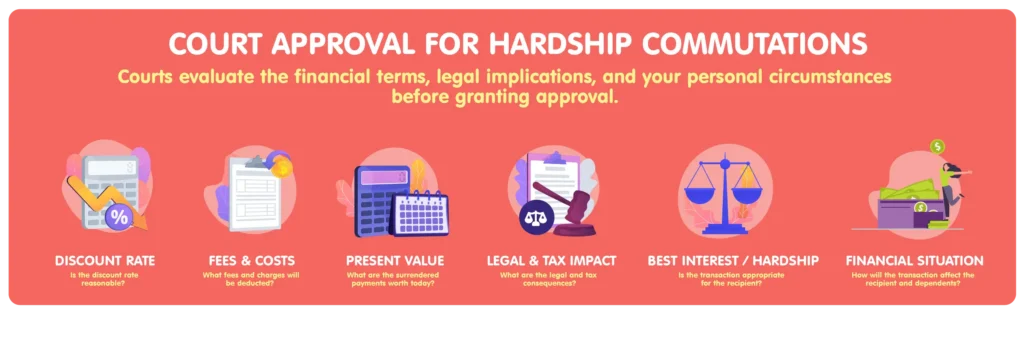
Whether you are pursuing a direct commutation with your annuity issuer or a factoring transaction, a court must approve it. Before granting a qualified order, the court will typically review:
- The discount rate applied to the transaction
- All fees, costs, and charges associated with the transfer
- The discounted present value of the payments being surrendered
- The legal and tax implications of the transfer
- Whether the transaction is in your best interest or is appropriate given your hardship
- Your current financial situation and the needs of any dependents
Courts take this review seriously. In a notable Rhode Island case, a judge refused to approve a factoring company’s purchase of a 28-year-old mother’s payments at a 60% discount off present value — a reminder that courts are intended to function as a meaningful check, not a rubber stamp.
Should I Sell My Structured Settlement Payments?
This is the most important question — and the honest answer is: not without exhausting every other option first.
Your structured settlement was designed to provide long-term financial security. Surrendering future payments for a discounted lump sum permanently reduces that security. Before pursuing any hardship commutation or factoring transaction, consider:
- Check whether your annuity issuer offers a hardship program. It costs nothing to ask, and if your issuer has one, it’s worth understanding the eligibility criteria, the discount rate, and the realistic timeline before deciding whether it fits your situation.
- Get a quote from the secondary market too. Comparing what a factoring company can offer — on rate, timeline, and terms — gives you a real basis for comparison rather than guessing which path is better.
- Explore non-sale alternatives. Personal loans, government assistance programs, negotiating medical bills, and other financial tools may address your need without sacrificing future income.
- Sell only what you need. A partial sale is always possible — you do not have to surrender all remaining payments.
- Understand the total cost. Get a quote that shows the discount rate, all fees, and the exact lump sum you will receive. Compare it to what your payments are worth in present value terms.
If you do decide to move forward, working with a knowledgeable structured settlement professional gives you the best chance of understanding your rights, comparing your real options, and getting a fair outcome — whichever path you choose.
Get a Free Quote and Professional Guidance
If you are considering a hardship commutation or thinking about selling your structured settlement payments, I can help you understand your options, evaluate any offer you’ve received, and determine whether your annuity issuer offers a direct program that would serve you better.
📞 Call Annuity Freedom today at (877) 547-3672 for a free, no-obligation consultation and discover how much your structured attorney fees are worth.
With more than 12 years of experience in structured settlements and annuities, my goal is to help you make an informed decision that protects your financial future — not to pressure you into a transaction.
Frequently Asked Questions: Structured Settlement Hardship Commutation
What is a hardship commutation for a structured settlement?
A hardship commutation is a process by which an annuitant converts some or all of their future structured settlement payments into an immediate lump sum due to a financial or medical emergency. The transaction must be approved by a court under 26 U.S.C. § 5891 and applicable state law. Depending on your annuity issuer, the commutation may be processed directly with the life insurance company or through a third-party factoring company.
Is a hardship commutation the same as selling my structured settlement?
Not exactly. In a commutation handled directly by your annuity issuer, the issuer terminates its obligation to make the surrendered payments and pays you a lump sum directly. In a factoring transaction, a third party purchases your right to receive those payments, and the issuer continues making payments — but to the factoring company. Both require court approval and result in you giving up future income in exchange for cash now.
Does Berkshire Hathaway offer a hardship commutation program?
Yes. Berkshire Hathaway offers the Hardship Exchange Program, which allows eligible annuitants to receive a lump sum directly from Berkshire. Berkshire uses a 6.5% annual discount rate and charges a $1,000 administrative fee if the court approves the transfer. Berkshire applies its own hardship standard for eligibility, which is generally stricter than the “best interests” standard most state courts apply to factoring transactions, so not every applicant will qualify.
What discount rate should I expect on a hardship commutation or factoring transaction?
If your annuity issuer offers a direct hardship program, the discount rate may be as low as 6.5% (Berkshire Hathaway’s current Hardship Exchange Program). Historically, Allstate offered a comparable program — the Advanced Funding Exchange Notice, at an 8% discount rate — to its own structured settlement annuitants before exiting the structured settlement business in 2013; that program is no longer available. Third-party structured settlement factoring companies typically charge discount rates ranging from 9% to 18%, reflecting a competitive secondary market built specifically around purchasing structured settlement payment rights — though qualifying sellers working with AnnuityFreedom.net’s network may access rates as low as 8%. A lower discount rate is appealing, but it’s only one factor — availability, approval odds, and timeline matter too, since an issuer’s hardship program is a secondary function of its business rather than its core focus.
Is court approval always required for a hardship commutation?
Yes. Any transfer of structured settlement payment rights — whether to the annuity issuer itself or to a third-party factoring company — requires a court-approved qualified order under 26 U.S.C. § 5891 and your state’s Structured Settlement Protection Act. No court approval means the transaction does not legally comply with federal and state law.
What does “hardship” mean for a structured settlement transfer?
The definition varies by state. Federal law under § 5891 allows approval when a transfer is appropriate in light of a hardship faced by the payee, but does not define the term. Michigan provides the most detailed definition, listing specific qualifying circumstances such as inability to pay for medical care, housing, transportation, education, or certain debts. Kentucky requires the payee to establish that the transfer is necessary to avoid imminent financial hardship. California treats hardship as one of 14 factors a court must weigh. Most other states use a “best interests” standard that does not require a hardship finding at all.
Is it hard to get approved for a hardship commutation directly with my annuity issuer?
It can be. Purchasing back structured settlement payment rights is not the core business of an annuity issuer — issuing and managing annuities is. As a result, issuer hardship programs often apply stricter eligibility criteria than the legal minimum, are staffed at a smaller scale relative to demand than a dedicated factoring company, and can take longer to process. Many applicants who apply directly to their issuer are declined or face a slow timeline. This doesn’t mean it’s not worth asking — there’s no cost to inquire — but it does mean you shouldn’t treat it as your only option if you have a real need for liquidity.
Can I sell only part of my structured settlement payments?
Yes. A partial sale — sometimes called a partial factoring — allows you to surrender only a portion of your future payments rather than all of them. This is almost always preferable to a full sale if your immediate cash need can be met with less. The court must still approve any partial transfer.
What happens if a factoring company does not comply with the law?
If a factoring company fails to comply with 26 U.S.C. § 5891 and applicable state SSPAs, the company may be subject to a 40% federal excise tax on the transaction. More importantly, the transfer may be void under state law, meaning it may not be legally enforceable. Always confirm that any company you work with obtains proper court approval.
About the Author: Jovan Johnson, Esq. is a structured settlement & annuity specialist with 12 years of experience, based in California. He has also practiced as an attorney in consumer and small business bankruptcy and debt settlement. Annuity Freedom has been helping clients sell annuity payments since 2017.
About the Reviewer: Kevin Lowe is the Chief Operating Officer of Genex Capital and has more than a decade of experience in specialty finance and the structured settlement secondary market. Since joining Genex in 2013, he has overseen transaction management, investor relations, compliance, and strategic initiatives across the United States, working closely with annuitants, investors, legal professionals, and financial institutions.