Written by Arthur Goldgaber
Reviewed by Jovan Johnson, Esq., Structured Settlement & Annuity Specialist
Industry-Reviewed by Kevin Lowe, COO of Genex Capital, Structured Settlement Secondary Market Specialist
Updated July 7, 2026
Unlock the value of your structured attorney fees:
- Structured legal fees allow plaintiff lawyers to choose to receive installment payments over time, tax deferred. A key tax case from 1994 upholds them.
- However, the IRS recently issued a tax memo that although not binding authority on anyone, suggests that the IRS may be targeting these tax benefits for plaintiff lawyers. There is no reason that lawyers cannot continue to structure their fees, and some lawyers seem to be doubling down with even more structured fees.
- However, paying attention to the details and the documents of structured fee agreements is now even more important.
- Attorneys who no longer need the structure can sell some or all of their future payments for a lump sum, subject to court approval.
What Are Structured Attorney’s Fees?
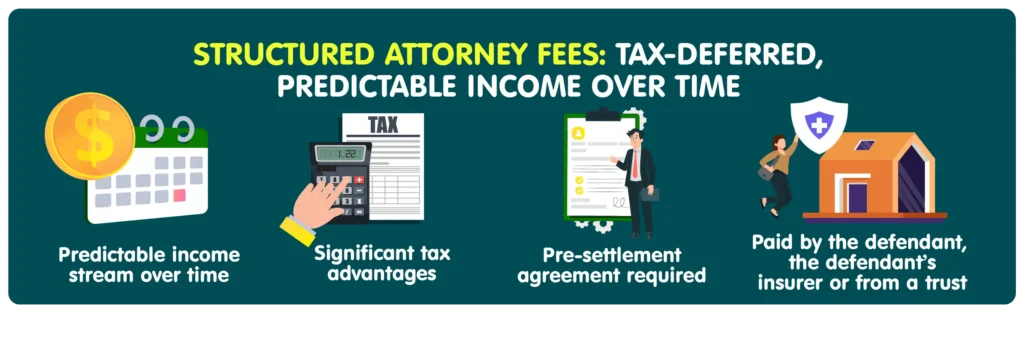
Structured attorney fees allow plaintiff lawyers to defer their compensation and receive it in periodic installments rather than a single lump sum. This strategy is typically structured through an annuity or other investment vehicle, providing attorneys with significant tax advantages and a predictable income stream over time. The settlement agreement must be completed before the verdict or settlement is reached. Structured legal fees typically apply to contingency cases that settle out of court, though in some situations they may also be arranged in cases that proceed to judgment or when attorneys’ fees are court-awarded. The funding for the structured settlement is paid by the defendant, the defendant’s insurer or from a trust.
A landmark tax case in 1994, Childs v. Commissioner, 103 T.C. 634 (1994), upheld the validity of structured fees, confirming their benefits for attorneys. However, an IRS memorandum issued in 2023, Chief Counsel Guidance Memorandum (GLAM) suggested that the agency may be scrutinizing structured fee arrangements more closely. While this memo is not binding law, it underscores the importance of careful documentation and compliance when structuring fees.
Attorneys remain committed to structured fees, and some are using them more than ever, since the financial advantages are clear when agreements are properly structured.
“Payments over time can flatten the peaks and valleys of a lawyer’s income and reduce the need to borrow to finance cases,” Robert W. Wood, ABA
How Structured Attorney Fees Work
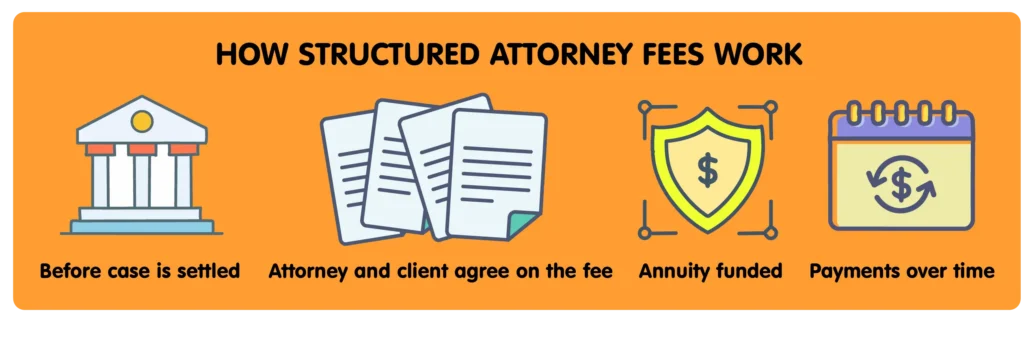
- Agreement – Before a case is settled, the attorney and client agree on the fee, with the attorney determining the structure.
- Assignment – The attorney assigns the right to receive future payments to a third-party assignment company.
- Funding – The defendant or insurer transfers the full fee amount to the assignment company.
- Annuity/Investment – The assignment company purchases an annuity or investment portfolio to generate the scheduled payments.
- Payment – The attorney receives income on the agreed schedule (monthly, annually, or future lump sums).
- Tax Deferral – Taxes are only due in the years payments are received, not at the time of settlement.
Key Benefits of Structured Attorney Fees

- Tax Deferral – Avoid paying taxes on the entire fee in one year, potentially lowering overall liability (IRS Rev. Rul. 79-220; IRC §451). Payments are reported to the IRS in the year that the attorney receives them. If payments are paid during retirements, they may be taxed at a lower rate. In contrast, if you choose to receive the fees upfront, the payment is usually fully taxable upon receipt.
- Income Smoothing – Turn irregular lump-sum fees into predictable income.
- Financial Planning – Support long-term goals such as retirement, education, or wealth transfer. Annuities often accrue interest, adding value over time.
- Reduced Risk – Payments are secured by the annuity provider, not the client or defendant.
Important Considerations
- Timing – The structure must be set up before settlement funds are distributed.
- No Constructive Receipt – Attorneys cannot have control of the funds, or the IRS may deem them taxable immediately.
- Documentation – Settlement agreements must clearly state terms to avoid compliance issues.
📌Pro Tip: Collaborate with experienced settlement consultants to ensure agreements comply with IRS requirements and avoid triggering “constructive receipt,” a tax doctrine where the IRS may consider funds taxable income even if not yet received. Also, experts advise that lawyers should stick with annuities to ensure that the arrangement is respected for tax purposes.
Why Retiring Attorneys Reconsider Structured Fees
Structured fees make sense during an active career, but retirement often shifts financial priorities:
- Reduced Need for Periodic Income – Retirees may prefer a lump sum for lifestyle changes, debt repayment, or investment opportunities.
- Changing Tax Benefits – Without a high annual income, deferring fees may not carry the same tax advantages.
- Estate Planning – A lump sum can simplify wealth transfers compared to multi-decade annuity streams.
Who Sells Structured Attorney Fees

Selling structured fees is helpful for attorneys in a range of situations:
- Plaintiff attorneys and law firms receiving structured attorney fee payments
- Attorneys planning retirement, career, or firm transitions
- Firms seeking liquidity for growth, overhead, taxes, or other substantial liabilities
Can You Sell Your Structured Attorney Fees?

Yes. Attorneys can sell some or all of their structured fee payments in exchange for an immediate lump sum. These transfers are regulated under the Structured Settlement Protection Acts and require court approval to ensure fairness.
As part of this process, a judge reviews the proposed transfer to confirm that it is voluntary, fair, and compliant with applicable law. Court approval is aimed at protecting all parties and ensures the enforceability of the transaction. Selling attorney fees does not affect the underlying client settlement or reopen the resolved matter.
Options for Selling Attorneys Fees

Attorneys interested in selling their future fees may sell in partial or in full. Partial sales allow for quick funding while maintaining future payments. Full sales allow for a clean exit from the structure.
How the Process Works
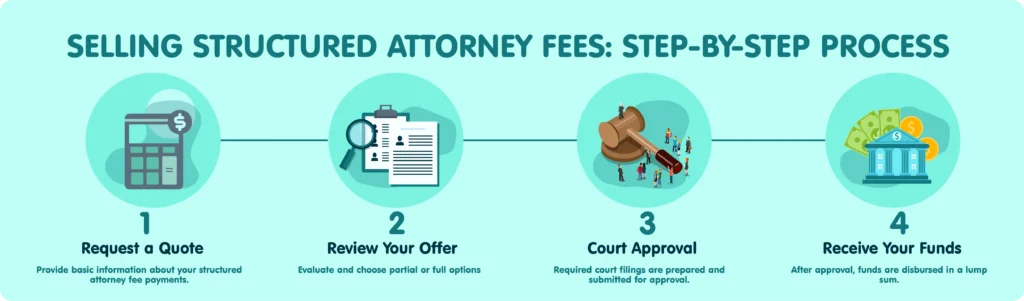
You can sell your structured attorneys fees in four simple steps:
- Request a Quote – Provide basic information about your structured fee payments.
- Review Your Offer – Evaluate partial or full sale options and select the structure that fits your needs. It is best to consult with a tax professional.
- Court Approval – The required court filings are prepared and submitted for approval.
- Receive Your Funds – Once approved, funds are disbursed in a lump sum.
Benefits of Selling Structured Fees
- Immediate Access to Cash – Cover retirement expenses, healthcare, or new ventures.
- Flexibility – Sell all or just part of your future payments.
- Simplicity – Consolidate complex payment schedules into a single, manageable sum.
How Does Selling Compare to an Attorney Loan?
Attorneys exploring liquidity options often weigh selling structured fees against an attorney loan against future fees. The two work differently:
- No repayment obligation – Selling structured fees is a sale, not a loan. There is no principal to repay and no interest accruing over time.
- No collateral or case-value reporting – Loans against case values typically require ongoing reporting on case status and collateral; selling structured payments does not.
- No time pressure – There is no repayment deadline or risk of default since the transaction is a completed sale once court-approved.
- Trade-off – In exchange for avoiding loan obligations, attorneys receive less than the full value of the future payments, similar to how a loan involves interest costs over time. Each attorney’s circumstances determine which option is more cost-effective.
Why Choose Annuity Freedom to Access Your Fees?
At Annuity Freedom, we’ve helped attorneys and professionals maximize the value of their structured settlements for more than a decade.
We provide:
- Years of Experience Purchasing Structured Settlement and Annuity Payment Streams
- Compliance with Federal and State Laws
- Transparent Valuations
Whether you’re preparing for retirement or simply want more liquidity, our team ensures you get the financial freedom you deserve.
Frequently Asked Questions
Can I sell only part of my structured attorney fees?
Yes. Attorneys can choose to sell a portion of their future payments while retaining the rest, or sell the full structure for a complete exit.
Does selling my structured attorney fees affect my client’s settlement?
No. Selling your fees is a separate transaction from your client’s underlying settlement and does not reopen or affect the resolved case.
How long does the court approval process take?
Timelines vary by state and court schedule, but most transfers require a formal hearing where a judge reviews the transaction for fairness before approval.
Will I owe taxes when I sell my structured attorney fees?
Tax treatment depends on your individual circumstances. Consult with a tax professional to understand the implications of a sale before proceeding.
How is selling structured attorney fees different from an attorney loan?
Selling is a completed transaction with no repayment obligation or interest, while a loan must be repaid with interest and may require ongoing reporting on case status.
Take Control of Your Financial Future
Your structured attorney fees gave you tax advantages during your career, but your needs may have changed. Selling your fees could unlock new opportunities.
📞 Call Annuity Freedom today at (877) 547-3672 for a free, no-obligation consultation and discover how much your structured attorney fees are worth.
Sources
- IRS Revenue Ruling 79-220 – Guidance on structured fee arrangements.
- 26 U.S. Code § 451 – Rules on timing of income inclusion.
- 26 U.S. Code § 5891 – Federal regulation of structured settlement transfers.
- American Bar Association – Attorney’s Fees & Structured Settlements
About the Reviewer: Jovan Johnson, Esq. is a structured settlement & annuity specialist with 12 years of experience, based in California. He has also practiced as an attorney in consumer and small business bankruptcy and debt settlement. Annuity Freedom has been helping clients sell annuity payments since 2017.
About the Reviewer: Kevin Lowe is the Chief Operating Officer of Genex Capital and has more than a decade of experience in specialty finance and the structured settlement secondary market. Since joining Genex in 2013, he has overseen transaction management, investor relations, compliance, and strategic initiatives across the United States, working closely with annuitants, investors, legal professionals, and financial institutions.